Chapter 03 of 12 · c. 800–1050
Life beneath the legends
Households and inequality
Most people in Viking Age Scandinavia lived through agricultural work rather than overseas adventure. Food, clothing, shelter and care required constant effort. Their society could offer influence and mobility to some while denying freedom to others.
1The working household
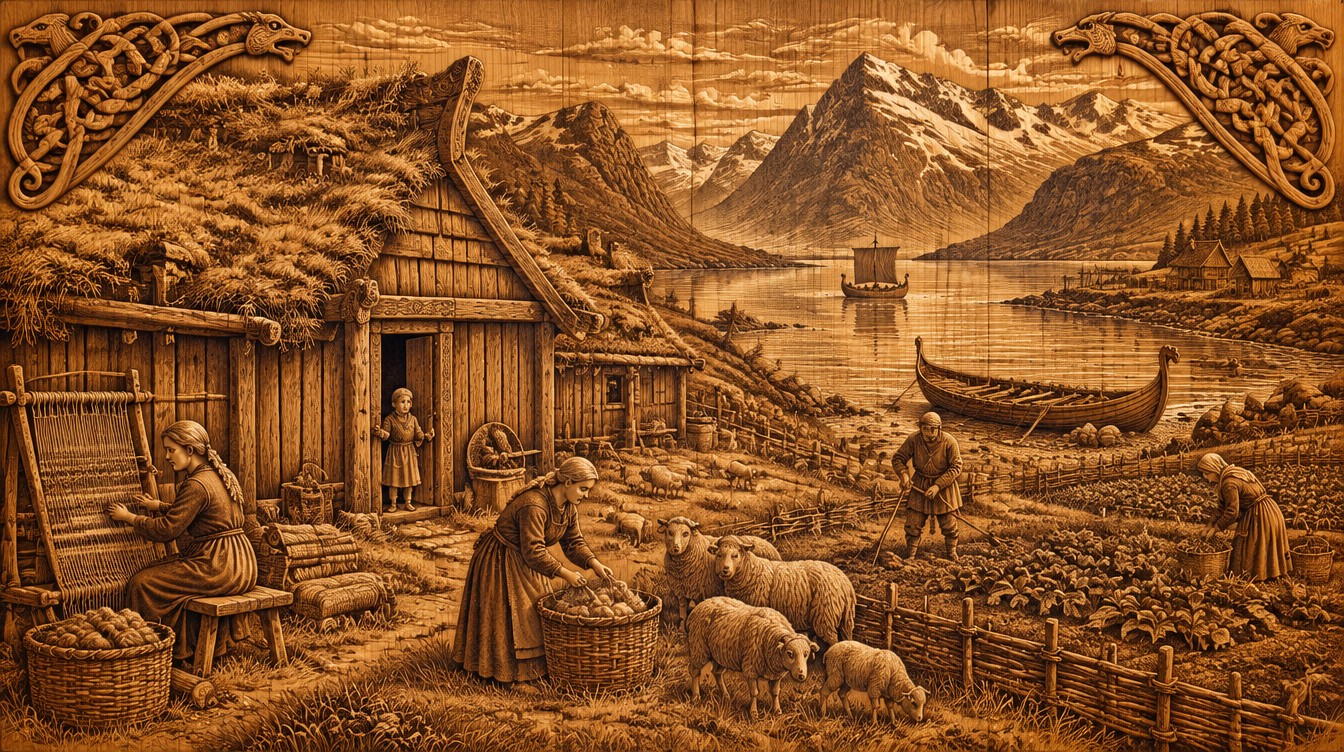
A farm was a place of production as well as residence. Cultivation, animal care, fishing, food preservation, repairs and textile work tied people to seasonal rhythms.
Households varied in size and wealth, and could include relatives, servants, workers and enslaved people. A rich burial is therefore a poor model for every home.
In towns, specialist crafts created tools, combs, jewellery and other goods for local and distant customers. Children learned through participation and play, and faced significant risks from illness and injury.
Their carefully prepared graves sometimes reveal affection and status, although burial gifts cannot reconstruct an entire childhood.
2Women, authority and evidence
Women’s work sustained farms, textile production and family networks. Some women controlled property or exercised substantial influence, particularly within prosperous households.
Such authority existed within a society shaped by inequalities of gender and status; it should not be mistaken for universal equality. Keys, brooches and textile tools can illuminate social presentation, but objects do not automatically identify everything a person did.
The same caution applies to weapons in graves. A weapon burial associated with a female skeleton deserves serious attention, yet one exceptional burial cannot establish the normal occupation of all women.
Regional variation and the difference between ritual display and lived experience remain essential.
3The people denied freedom
Enslaved people, often called thralls, worked in households and fields and were bought, sold and transported. Captivity might follow a raid, while dependency could also arise through birth or debt.
Such people could be separated from family and subjected to violence and sexual exploitation. Some obtained freedom, but that possibility did not remove the coercion of the institution.
Their numbers cannot be securely calculated for all Scandinavia. Shackles and written references offer important evidence, yet many forms of unfree labour leave no obvious archaeological signature.
A history that celebrates ships, trade and free assemblies while omitting slavery reproduces the viewpoint of the powerful.